


Presage Arterial Pressure Waveform and Pulse Rate Model Card
1. Model Details
Basic info: Presage vitals by video analysis generates a relative arterial pressure waveform and pulse rate from a video of a subject. This card covers 10.6-second pulse rate (vs EKG) and 60-second waveform analysis (vs BP).
Organization: Presage Technologies
Model date: 2026-11-06
Model version: d205a6f0
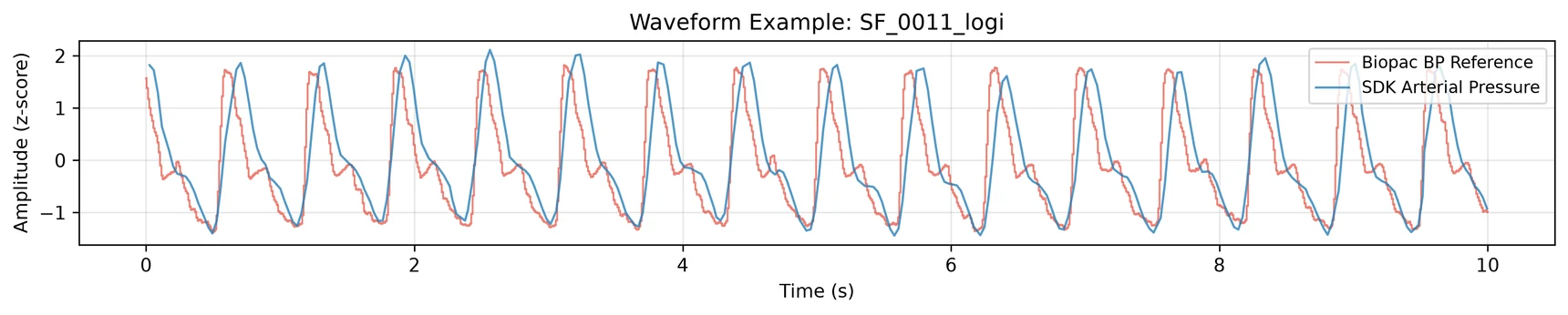
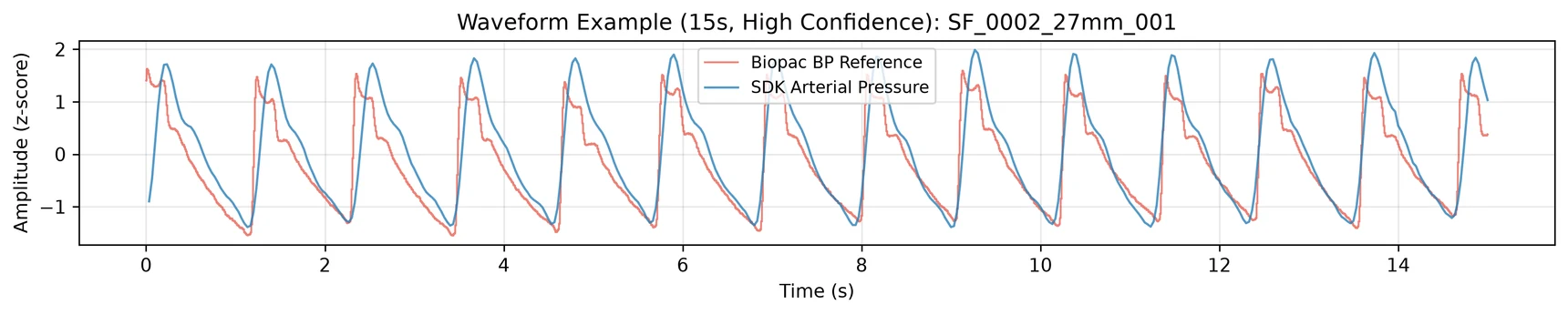
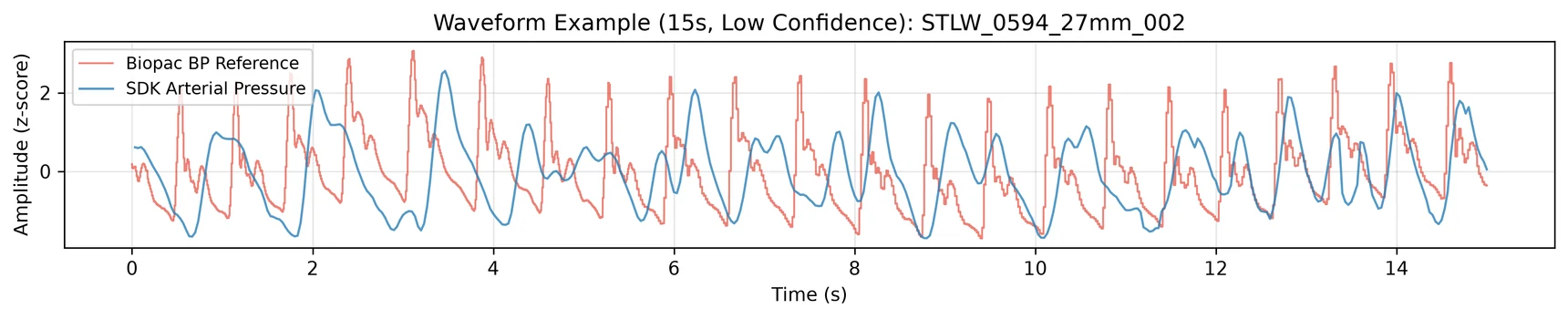
Model type: A proprietary computer vision and signal processing pipeline extracts a relative arterial pressure waveform and pulse rate from video of a subject. Pulse rate is compared against EKG at 10.6s windows. The waveform is z-score normalized and compared against the Biopac BP reference at 60s windows.
License: The algorithm is currently proprietary, and licenses are granted with predefined agreement.
Contact: Questions can be sent to: support@presagetech.com
2. Intended Use
Model Uses
This model was intended for use in the analysis and non-diagnostic utility of arterial pressure waveform morphology and pulse rate. Requires a stationary device and video of a subject acquired at 25+ fps. Pulse rate range: 40-180 BPM.
Out-of-Scope Uses
As noted above. Not intended for diagnostic blood pressure measurement. Does not provide absolute systolic, diastolic, or MAP values in mmHg. Not an arrhythmia detection or monitoring device.
3. Validation
Reference Standard: Biopac MP160 3-lead ECG (for pulse rate comparison at 10.6s windows) and Biopac continuous blood pressure monitor (for waveform correlation at 60s windows). Waveforms z-score normalized before comparison.
Comparison Methodology: Arterial Pressure Waveform measurements from the camera-based system were compared against time-aligned reference measurements. Ground truth signals were checked for quality using labeled signal annotations; segments with poor signal quality were excluded from analysis.
4. Data Demographics
| Category | Distribution |
|---|---|
| Total | 118 subjects, 413 videos |
| Camera (videos) | Logitech C920: 113, e-con See3CAM CU27: 111, Samsung S24 Rear 24mm (tripod): 99, Samsung S24 Front 27mm (handheld): 90 |
| Sex (subjects) | Female: 63, Male: 55 |
| Age Group (subjects) | 18-25: 33, 26-35: 39, 36-45: 18, 46-55: 13, 56-65: 12, 65+: 2 |
| Fitzpatrick (subjects) | Type 1: 21, Type 2: 12, Type 3: 13, Type 4: 24, Type 5: 33, Type 6: 15 |
| BMI (subjects) | Mean: 27.9, Range: 16.5–54.3, N=118 |
| Lighting (videos) | Ring Light: 131, Lamp: 130, Window: 98 |
Reference standard: Biopac EKG and continuous blood pressure monitor.
5. Data Provenance
Reference Instrumentation: Biopac research-grade physiological sensors: 3-lead ECG (for pulse rate ground truth), continuous blood pressure monitor (for waveform correlation ground truth).
Camera Devices Tested: Samsung S24 Rear 24mm (tripod), Samsung S24 Front 27mm (handheld), e-con See3CAM CU27 (USB), Logitech C920 (tripod).
Average Camera Distance: Samsung S24/e-con/Logitech: 26", Samsung S24 handheld: 10"
Data Handling: All subject data is de-identified. Derived metrics and anonymized identifiers are retained. Data is securely stored with access restricted to trained researchers.
6. Factors
The arterial pressure model requires face detection and high-quality photoplethysmographic signal extraction.
- User: Face must be visible, illuminated, and still.
- Environment: Stable lighting is critical for waveform quality.
These factors can affect model performance:
- Lighting: Temporal lighting changes degrade waveform quality.
- Motion: Any motion introduces artifacts in the pressure trace.
- User: Demographics including skin tone may impact signal quality.
- Chewing gum can degrade performance.
Lighting Conditions Tested:
- Ring Light: Direct, front-facing illumination providing consistent lighting on the subject's face.
- Window: Natural sunlight entering through a window that illuminates the subject's face from the side rather than directly head-on. Lighting intensity varies depending on weather conditions and the time of day when the measurement is collected.
- Lamp: A room lighting lamp aimed at the ceiling and not directed at the participant, to mimic living room-like environments.
Other factors:
- Instrumentation: Camera parameter locking (exposure, gain, white balance) is essential.
7. Metrics
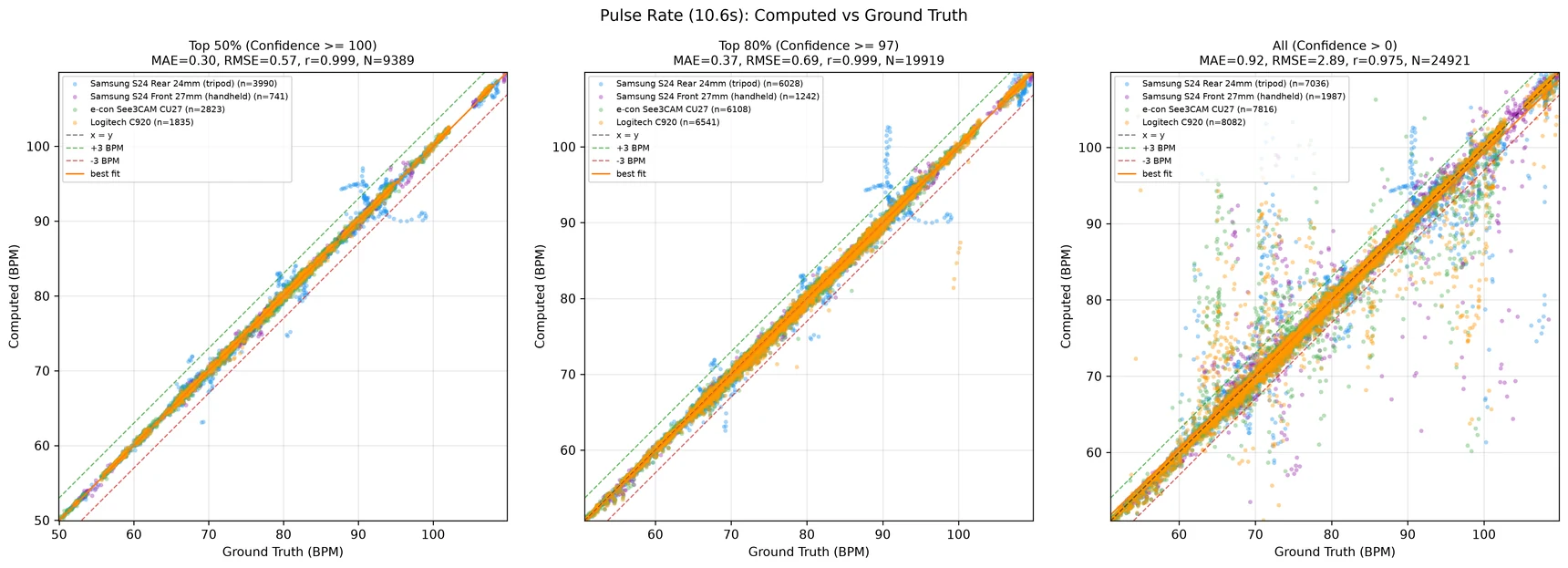
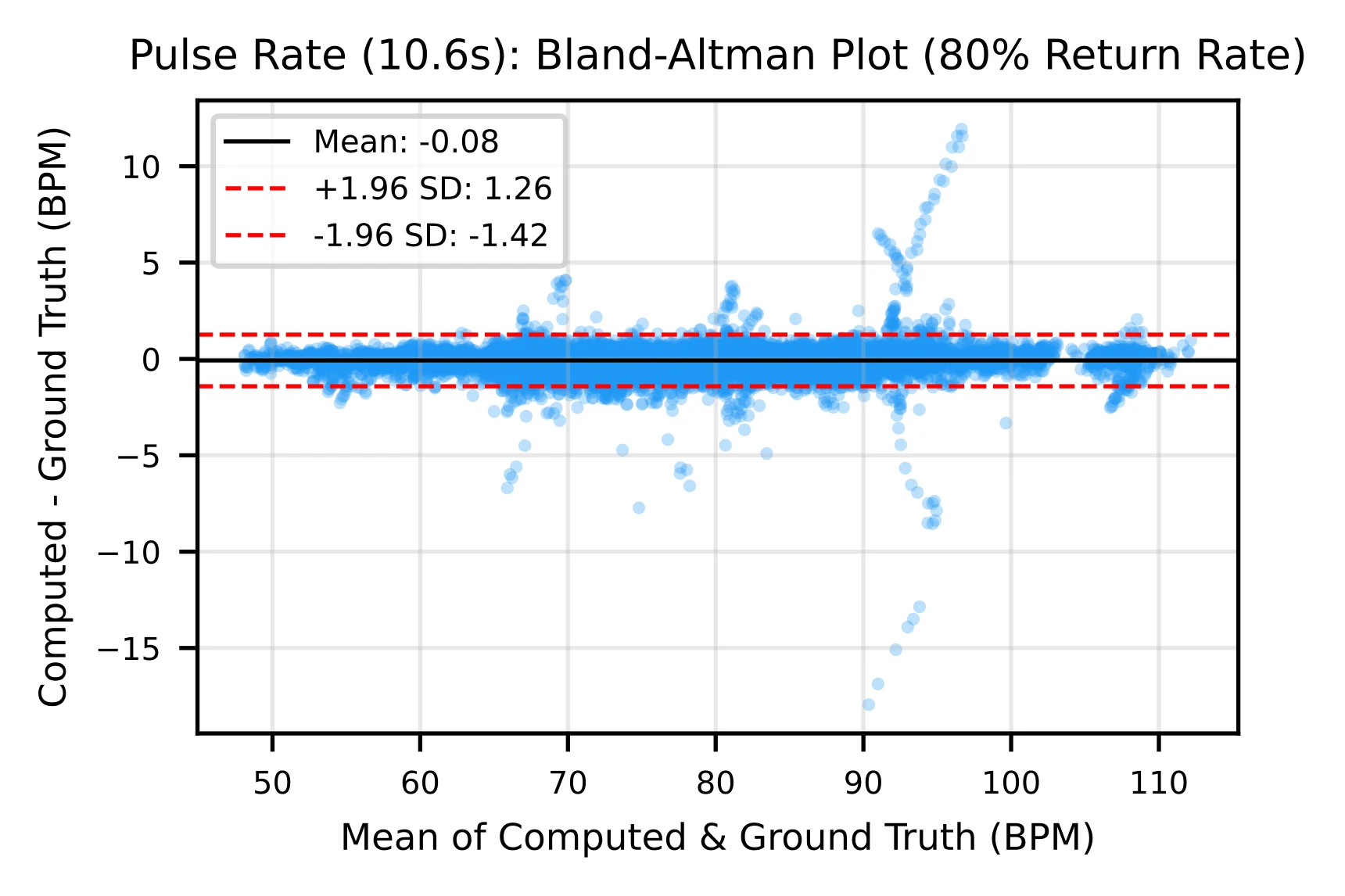
(at 80% Return Rate, Confidence >= 97)
- MAE: 0.37 BPM
- RMSE: 0.69 BPM
8. Quantitative Analysis
Computed vs Ground Truth at Confidence Thresholds
Bland-Altman Plot
Confidence Lookup Table
| Confidence >= | MAE (BPM) | RMSE (BPM) | Pearson r | Return Rate (%) | N (samples) |
|---|---|---|---|---|---|
| 0 | 0.93 | 2.96 | 0.974 | 100.0 | 24957 |
| 10 | 0.90 | 2.82 | 0.976 | 99.6 | 24869 |
| 20 | 0.88 | 2.74 | 0.978 | 99.4 | 24801 |
| 30 | 0.83 | 2.55 | 0.981 | 98.9 | 24675 |
| 40 | 0.79 | 2.39 | 0.983 | 98.2 | 24518 |
| 50 | 0.72 | 2.13 | 0.986 | 97.3 | 24290 |
| 60 | 0.64 | 1.81 | 0.990 | 96.1 | 23984 |
| 65 | 0.60 | 1.60 | 0.992 | 95.2 | 23770 |
| 70 | 0.56 | 1.42 | 0.994 | 94.4 | 23554 |
| 75 | 0.52 | 1.25 | 0.995 | 93.4 | 23322 |
| 80 | 0.49 | 1.08 | 0.996 | 92.5 | 23077 |
| 85 | 0.45 | 0.94 | 0.997 | 91.2 | 22751 |
| 90 | 0.42 | 0.81 | 0.998 | 89.3 | 22297 |
| 95 | 0.39 | 0.72 | 0.998 | 84.8 | 21172 |
| 96 | 0.38 | 0.70 | 0.998 | 82.8 | 20674 |
| 97 | 0.37 | 0.69 | 0.999 | 80.0 | 19919 |
| 98 | 0.35 | 0.64 | 0.999 | 74.3 | 18553 |
| 99 | 0.32 | 0.59 | 0.999 | 63.8 | 15930 |
Performance
(at 80% Return Rate, Confidence >= 97)
By Camera Type
| Camera Type | N (samples) | Return Rate (%) | MAE (BPM) | RMSE (BPM) | Pearson r |
|---|---|---|---|---|---|
| Samsung S24 Rear 24mm (tripod) | 6028 | 85.5 | 0.43 | 0.91 | 0.998 |
| Samsung S24 Front 27mm (handheld) | 1242 | 62.3 | 0.36 | 0.52 | 0.999 |
| e-con See3CAM CU27 | 6108 | 78.0 | 0.34 | 0.48 | 0.999 |
| Logitech C920 | 6541 | 80.9 | 0.33 | 0.65 | 0.999 |
By Fitzpatrick Skin Type
| Fitzpatrick | N (samples) | Return Rate (%) | MAE (BPM) | RMSE (BPM) | Pearson r |
|---|---|---|---|---|---|
| Type I | 4032 | 93.2 | 0.33 | 0.53 | 0.999 |
| Type II | 2368 | 89.6 | 0.27 | 0.39 | 1.000 |
| Type III | 2649 | 93.0 | 0.49 | 1.14 | 0.997 |
| Type IV | 4422 | 87.2 | 0.33 | 0.49 | 0.999 |
| Type V | 5031 | 72.6 | 0.37 | 0.72 | 0.998 |
| Type VI | 1417 | 45.1 | 0.49 | 0.78 | 0.998 |
| Fitzpatrick Type VI: Breakdown by Lighting Condition | |||||
| Ring Light | 526 | 53.2 | 0.36 | 0.48 | 0.997 |
| Window | 327 | 34.2 | 0.55 | 0.78 | 0.999 |
| Lamp | 427 | 40.4 | 0.60 | 1.07 | 0.986 |
Note: Types I-V are composites across all lighting conditions (Ring Light, Window, Lamp).
By Sex
| Sex | N (samples) | Return Rate (%) | MAE (BPM) | RMSE (BPM) | Pearson r |
|---|---|---|---|---|---|
| Male | 10045 | 82.7 | 0.35 | 0.70 | 0.999 |
| Female | 9874 | 77.1 | 0.38 | 0.68 | 0.998 |
By Age Group
| Age Group | N (samples) | Return Rate (%) | MAE (BPM) | RMSE (BPM) | Pearson r |
|---|---|---|---|---|---|
| 18-25 | 5497 | 82.1 | 0.46 | 0.90 | 0.997 |
| 26-35 | 6546 | 80.3 | 0.33 | 0.46 | 0.999 |
| 36-45 | 2790 | 74.0 | 0.38 | 0.63 | 0.999 |
| 46-55 | 2574 | 84.3 | 0.27 | 0.44 | 1.000 |
| 56-65 | 2271 | 85.4 | 0.26 | 0.35 | 0.999 |
| 65+ | 65 | 16.4 | 1.80 | 4.64 | 0.971 |
By Lighting Type
| Lighting | N (samples) | Return Rate (%) | MAE (BPM) | RMSE (BPM) | Pearson r |
|---|---|---|---|---|---|
| Lamp | 6059 | 77.2 | 0.43 | 0.98 | 0.996 |
| Ring Light | 6790 | 83.4 | 0.33 | 0.48 | 0.999 |
| Window | 4086 | 72.1 | 0.36 | 0.57 | 0.999 |
Confidence vs Waveform Correlation
| Confidence >= | Waveform Pearson r | Return Rate (%) | N (videos) |
|---|---|---|---|
| 0 | 0.683 | 100.0 | 370 |
| 10 | 0.683 | 100.0 | 370 |
| 20 | 0.683 | 100.0 | 370 |
| 30 | 0.683 | 100.0 | 370 |
| 40 | 0.687 | 99.2 | 367 |
| 50 | 0.693 | 97.8 | 362 |
| 60 | 0.697 | 96.2 | 356 |
| 65 | 0.700 | 95.1 | 352 |
| 70 | 0.704 | 93.5 | 346 |
| 75 | 0.707 | 92.2 | 341 |
| 80 | 0.709 | 90.3 | 334 |
| 85 | 0.716 | 87.3 | 323 |
| 90 | 0.720 | 84.3 | 312 |
| 95 | 0.731 | 78.4 | 290 |
| 96 | 0.739 | 75.7 | 280 |
| 97 | 0.738 | 71.1 | 263 |
| 98 | 0.740 | 66.2 | 245 |
| 99 | 0.736 | 55.4 | 205 |
Waveform Example
9. Fairness & Equity
Bias Assessment Methodology: Performance is stratified by Fitzpatrick skin type (I-VI), sex, camera type, and age group. Per-group metrics and Confidence averages are reported in the Quantitative Analysis tables above.
10. Ethical Considerations
As a remote sensing device, the risks posed to the subjects in the trial are minimal, including the association of each subject with corresponding biometric data. Mitigation of these risks include de-identifying all subject data, including videos, prior to saving it. Additionally, all data is securely stored with access to a select number of trained researchers.The model is not intended for human life-critical decisions, diagnostics or prognostication.
11. Limitations and Tradeoffs
- Provides relative waveform morphology, not absolute mmHg values
- Works best in stationary conditions with locked camera parameters
- Requires sufficient illumination for signal extraction