


Presage Breathing Model Card
1. Model Details
Basic info: Presage vitals by video analysis generates breathing rate metrics from a video of a subject.
Organization: Presage Technologies
Model date: 2026-11-06
Model version: d205a6f0
Model type: A proprietary computer vision and signal processing pipeline that estimates breathing rate and breathing waveform from video of a subject.
License: The algorithm is currently proprietary, and licenses are granted with predefined agreement.
Contact: Questions can be sent to: support@presagetech.com
2. Intended Use
Model Uses
This breathing model was intended for use in the analysis and non-diagnostic utility of breathing mechanics. It was intended to be used with a video from a stationary device that contains the subject's face, chest and shoulders in view. It requires approximately 45 seconds of uninterrupted data. It is only intended to measure breathing rate values in the range of 4-40 breaths per minute.
Out-of-Scope Uses
As noted above. The Presage breathing model is not intended for diagnostic purposes. No alarms are provided and it is not an apnea monitoring or detection model.
3. Validation
Reference Standard: ETCO2 capnography via Biopac MP160. For each SDK breathing-rate timestamp t, the CO2 reference breathing rate is computed from CO2 peaks detected in a 30-second lookback window ending at t:
Comparison Methodology: Breathing measurements from the camera-based system were compared against time-aligned reference measurements. Ground truth signals were checked for quality using labeled signal annotations; segments with poor signal quality were excluded from analysis.
4. Data Demographics
| Category | Distribution |
|---|---|
| Total | 93 subjects, 184 videos |
| Camera (videos) | Samsung S24 Rear 24mm (tripod): 92, Logitech C920: 92 |
| Sex (subjects) | Female: 50, Male: 43 |
| Age Group (subjects) | 18-25: 29, 26-35: 39, 36-45: 12, 46-55: 6, 56-65: 6, 65+: 1 |
| Fitzpatrick (subjects) | Type 1: 14, Type 2: 14, Type 3: 7, Type 4: 24, Type 5: 21, Type 6: 13 |
| Lighting (videos) | Ring Light: 184 |
Reference standard: ETCO2 via biopac peak detection for breathing rate ground truth.
5. Data Provenance
Reference Instrumentation: Biopac research-grade physiological sensors: ETCO2 capnography (for breathing rate ground truth).
Camera Devices Tested: Samsung S24 Rear 24mm (tripod), Logitech C920 (tripod).
Average Camera Distance: Logitech C920: 36", Samsung S24 Rear 24mm: 39"
Data Handling: All subject data is de-identified. Derived metrics and anonymized identifiers are retained. Data is securely stored with access restricted to trained researchers.
6. Factors
The breathing metric model requires face and pose detection to identify the subject's chest region for motion analysis.
- User: User's face and chest must be sufficiently visible and positioned within the imaging window.
- Environment: Model is developed on images with various lighting and motion conditions.
These factors can affect model performance:
- Lighting: Temporal changes in lighting affect feature tracking ability.
- Clothing: Dark solid shirts in low lighting can challenge feature tracking.
- Motion: Breathing model cannot tolerate large non-physiological motion or talking.
- Chewing gum can degrade performance.
Lighting Conditions Tested:
- Ring Light: Direct, front-facing illumination providing consistent lighting on the subject's face.
Other factors:
- Instrumentation: Several cameras have been tested for efficacy.
7. Metrics
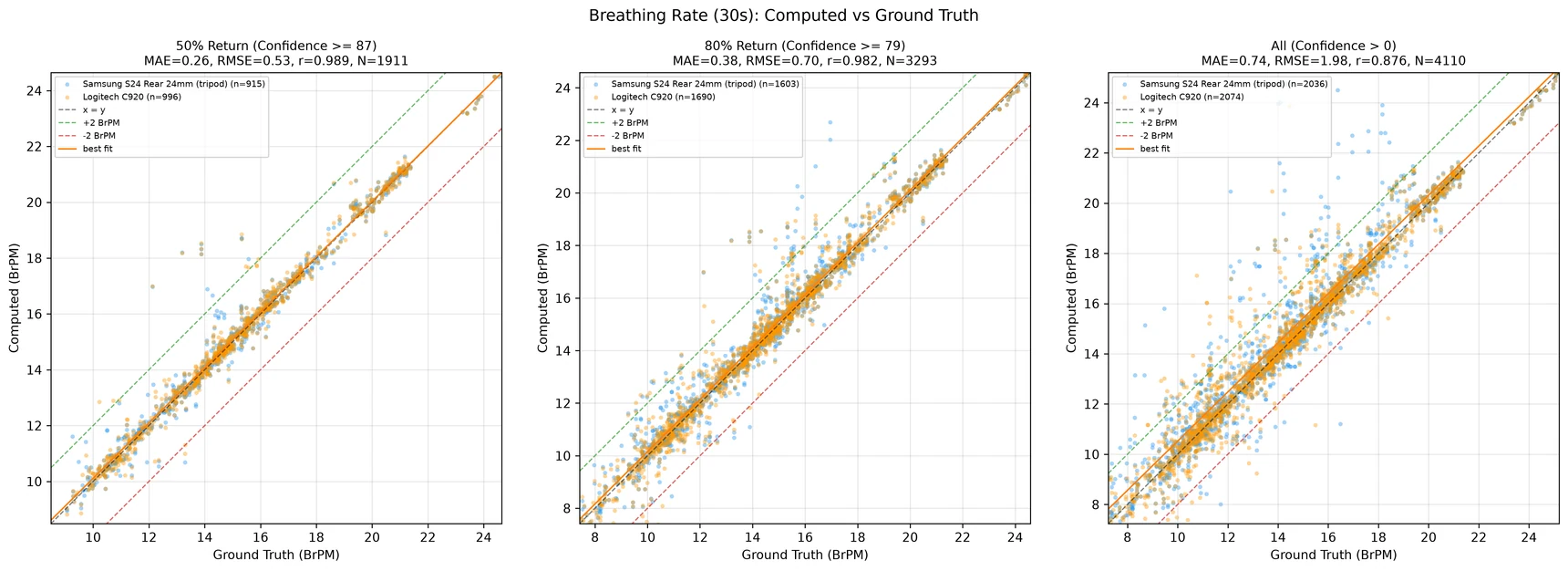
(at 80% Return Rate, Confidence >= 79)
- MAE: 0.38 BrPM
- RMSE: 0.70 BrPM
8. Quantitative Analysis
Computed vs Ground Truth at Confidence Thresholds
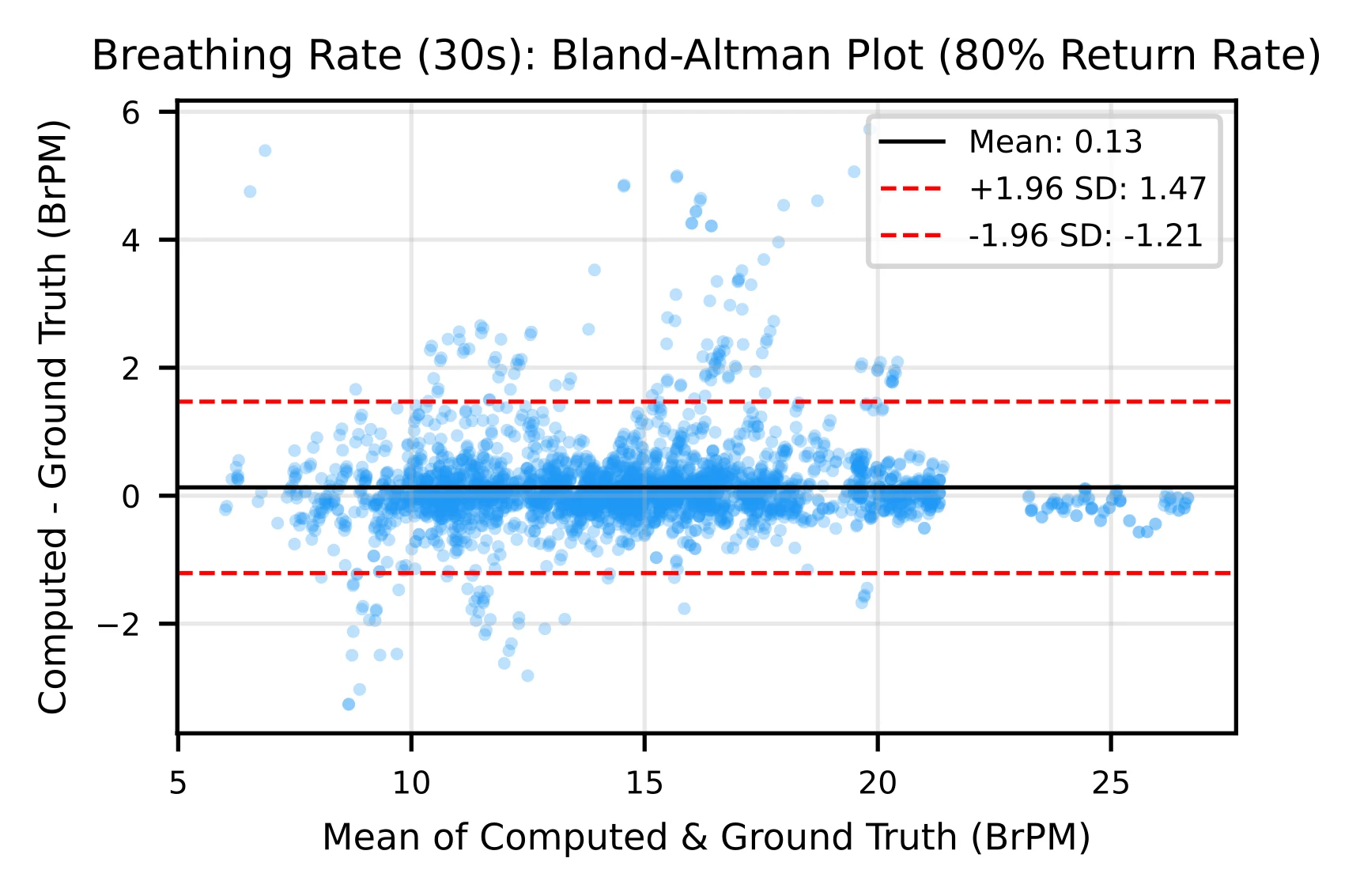
Bland-Altman Plot
Confidence Lookup Table
| Confidence >= | MAE (BrPM) | RMSE (BrPM) | Pearson r | Return Rate (%) | N (samples) |
|---|---|---|---|---|---|
| 0 | 0.74 | 1.98 | 0.876 | 100.0 | 4110 |
| 10 | 0.74 | 1.98 | 0.876 | 100.0 | 4110 |
| 20 | 0.73 | 1.94 | 0.880 | 99.9 | 4107 |
| 30 | 0.70 | 1.84 | 0.890 | 99.5 | 4091 |
| 40 | 0.65 | 1.67 | 0.907 | 98.3 | 4041 |
| 50 | 0.52 | 1.15 | 0.953 | 95.5 | 3924 |
| 60 | 0.48 | 0.93 | 0.969 | 93.5 | 3842 |
| 65 | 0.45 | 0.84 | 0.974 | 91.9 | 3778 |
| 70 | 0.43 | 0.77 | 0.979 | 89.2 | 3666 |
| 75 | 0.41 | 0.74 | 0.980 | 85.6 | 3517 |
| 79 | 0.38 | 0.70 | 0.982 | 80.0 | 3293 |
| 80 | 0.37 | 0.69 | 0.983 | 78.2 | 3215 |
| 85 | 0.30 | 0.57 | 0.988 | 60.6 | 2491 |
| 90 | 0.20 | 0.40 | 0.992 | 11.5 | 471 |
Performance
(at 80% Return Rate, Confidence >= 79)
By Camera Type
| Camera Type | N (samples) | Return Rate (%) | MAE (BrPM) | RMSE (BrPM) | Pearson r |
|---|---|---|---|---|---|
| Samsung S24 Rear 24mm (tripod) | 1603 | 78.7 | 0.39 | 0.72 | 0.982 |
| Logitech C920 | 1690 | 81.5 | 0.37 | 0.68 | 0.983 |
By Fitzpatrick Skin Type
| Fitzpatrick | N (samples) | Return Rate (%) | MAE (BrPM) | RMSE (BrPM) | Pearson r |
|---|---|---|---|---|---|
| Type I | 406 | 70.6 | 0.50 | 0.89 | 0.977 |
| Type II | 454 | 75.5 | 0.32 | 0.50 | 0.990 |
| Type III | 248 | 82.4 | 0.34 | 0.50 | 0.982 |
| Type IV | 839 | 84.2 | 0.29 | 0.50 | 0.992 |
| Type V | 849 | 85.0 | 0.33 | 0.59 | 0.989 |
| Type VI | 497 | 77.9 | 0.59 | 1.09 | 0.912 |
Note: All Fitzpatrick types were tested under Ring Light only.
By Sex
| Sex | N (samples) | Return Rate (%) | MAE (BrPM) | RMSE (BrPM) | Pearson r |
|---|---|---|---|---|---|
| Male | 1480 | 76.7 | 0.44 | 0.84 | 0.976 |
| Female | 1813 | 83.1 | 0.33 | 0.56 | 0.988 |
By Age Group
| Age Group | N (samples) | Return Rate (%) | MAE (BrPM) | RMSE (BrPM) | Pearson r |
|---|---|---|---|---|---|
| 18-25 | 936 | 72.6 | 0.44 | 0.80 | 0.977 |
| 26-35 | 1343 | 83.5 | 0.38 | 0.72 | 0.981 |
| 36-45 | 554 | 90.1 | 0.30 | 0.49 | 0.984 |
| 46-55 | 226 | 72.0 | 0.40 | 0.72 | 0.986 |
| 56-65 | 213 | 82.6 | 0.26 | 0.49 | 0.992 |
| 65+ | 21 | 84.0 | 0.21 | 0.25 | 0.957 |
By Lighting Type
| Lighting | N (samples) | Return Rate (%) | MAE (BrPM) | RMSE (BrPM) | Pearson r |
|---|---|---|---|---|---|
| Ring Light | 3293 | 80.1 | 0.38 | 0.70 | 0.982 |
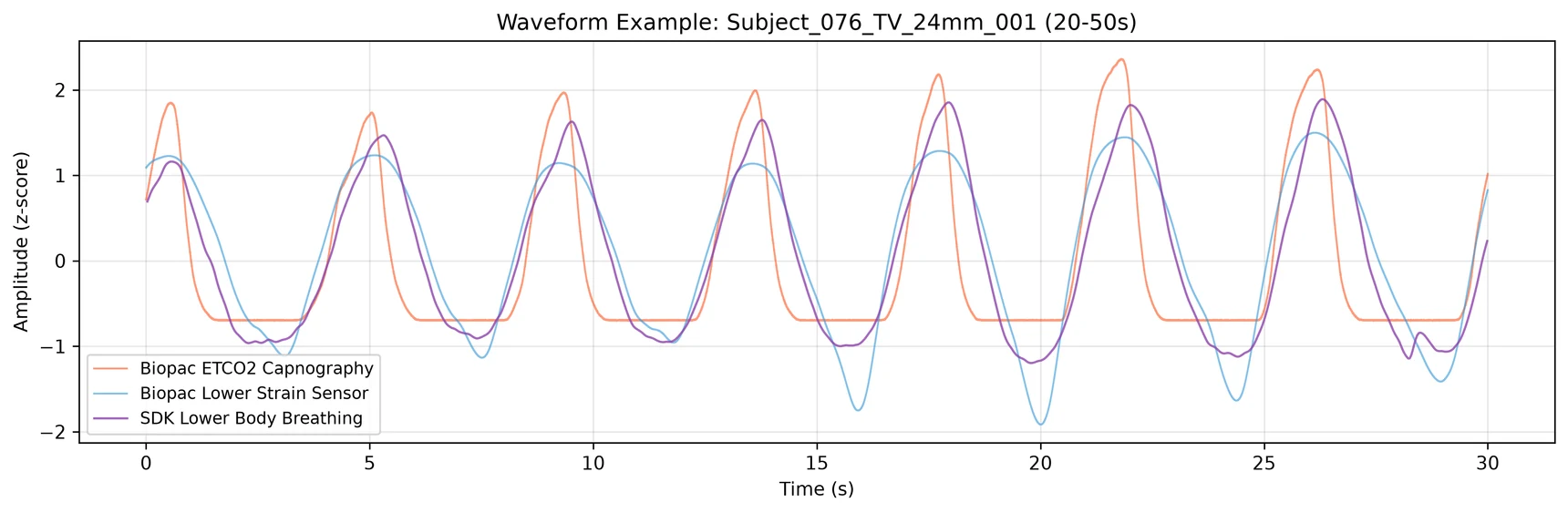
Confidence vs Breathing Waveform Correlation
| Confidence >= | Upper Waveform Pearson r | Lower Waveform Pearson r | Return Rate (%) | N (videos) |
|---|---|---|---|---|
| 0 | 0.795 | 0.614 | 100.0 | 184 |
| 10 | 0.795 | 0.614 | 100.0 | 184 |
| 20 | 0.795 | 0.614 | 100.0 | 184 |
| 30 | 0.795 | 0.614 | 100.0 | 184 |
| 40 | 0.798 | 0.615 | 99.5 | 183 |
| 50 | 0.808 | 0.614 | 97.8 | 180 |
| 60 | 0.828 | 0.639 | 93.5 | 172 |
| 65 | 0.839 | 0.646 | 91.8 | 169 |
| 70 | 0.844 | 0.657 | 88.0 | 162 |
| 75 | 0.848 | 0.658 | 83.2 | 153 |
| 80 | 0.857 | 0.643 | 72.8 | 134 |
| 85 | 0.876 | 0.642 | 49.5 | 91 |
| 90 | 0.933 | 0.684 | 1.6 | 3 |
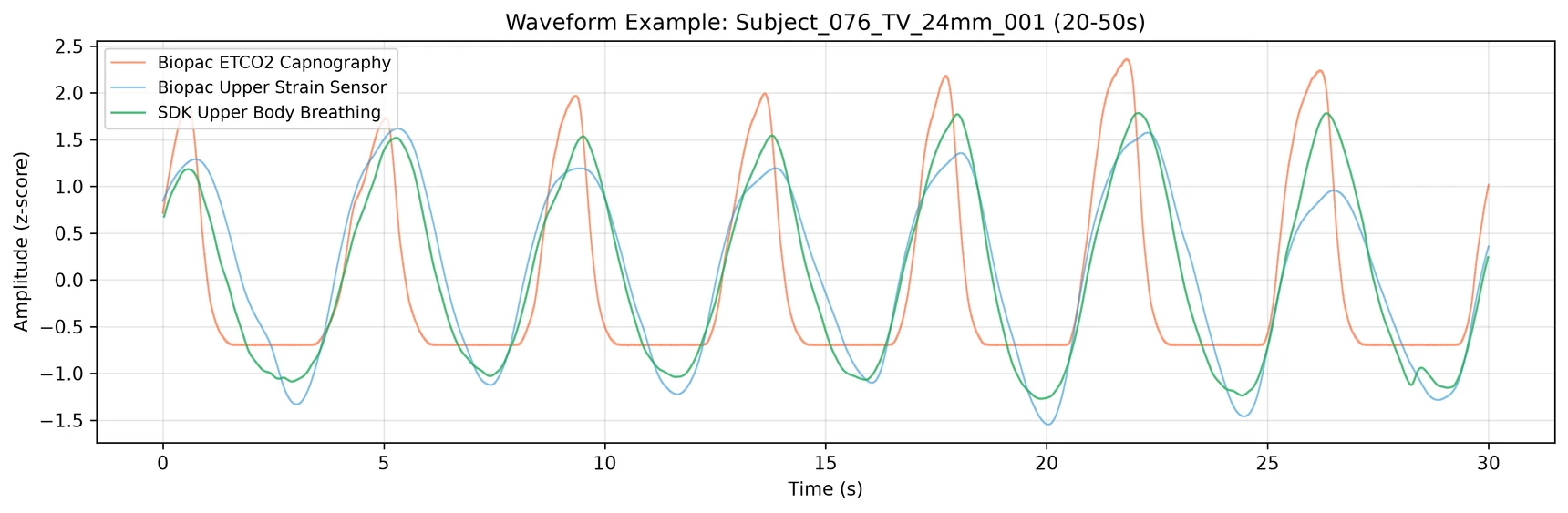
Waveform Example
9. Fairness & Equity
Bias Assessment Methodology: Performance is stratified by Fitzpatrick skin type (I-VI), sex, camera type, and age group. Per-group metrics and Confidence averages are reported in the Quantitative Analysis tables above.
10. Ethical Considerations
As a remote sensing device, the risks posed to the subjects in the trial are minimal, including the association of each subject with corresponding biometric data. Mitigation of these risks include de-identifying all subject data, including videos, prior to saving it. Additionally, all data is securely stored with access to a select number of trained researchers.The model is not intended for human life-critical decisions, diagnostics or prognostication.
11. Limitations and Tradeoffs
- Does not work when the camera or phone is handheld; both the camera and the subject must be stationary
- Requires at least 15 seconds of uninterrupted view of face and chest area
- Currently only measures a single subject at a time
- Talking during measurement invalidates breathing rate
- A confidence value of 0 indicates the algorithm has not yet accumulated 30 seconds of data; no breathing rate estimate is produced until the 30-second warm-up period completes
- Handheld (front-facing 27mm) camera data is excluded from this analysis because the camera must be stationary and the subject must remain still for accurate measurement