


Presage HRV Model Card
1. Model Details
Basic info: Presage vitals by video analysis generates heart rate variability metrics (RMSSD, SDNN, Baevsky Stress Index) from a video of a subject. Output frequency: one measurement per 60 seconds.
Organization: Presage Technologies
Model date: 2026-11-06
Model version: d205a6f0
Model type: A proprietary computer vision and signal processing pipeline extracts a photoplethysmogram (PPG) from video of a subject, from which NN intervals are derived. HRV metrics reported: RMSSD = sqrt(mean((NNi+1 - NNi)2)), the root mean square of successive NN differences (ms); SDNN = sqrt(mean((NNi - mean(NN))2)), the standard deviation of NN intervals (ms); and Baevsky Stress Index = AMo / (2 × Mo × MxDMn), a measure of autonomic balance derived from the NN interval distribution.
License: The algorithm is currently proprietary, and licenses are granted with predefined agreement.
Contact: Questions can be sent to: support@presagetech.com
2. Intended Use
Model Uses
This HRV model was intended for use in analysis and non-diagnostic utility of HRV. It requires at least 60 consecutive seconds of unobstructed facial view acquired at 25+ fps. Only intended for participants with pulse rate 40-180 BPM.
Out-of-Scope Uses
As noted above. Not intended for diagnostic purposes, arrhythmia detection, or monitoring. Not intended for highly dynamic environments.
3. Validation
Reference Standard: Biopac MP160 3-lead ECG. R-peaks detected from ECG; NN intervals computed; HRV metrics derived from NN intervals over matched 60-second windows.
Comparison Methodology: HRV (RMSSD, SDNN, Baevsky) measurements from the camera-based system were compared against time-aligned reference measurements. Ground truth signals were checked for quality using labeled signal annotations; segments with poor signal quality were excluded from analysis.
4. Data Demographics
| Category | Distribution |
|---|---|
| Total | 118 subjects, 413 videos |
| Camera (videos) | Logitech C920: 113, e-con See3CAM CU27: 111, Samsung S24 Rear 24mm (tripod): 99, Samsung S24 Front 27mm (handheld): 90 |
| Sex (subjects) | Female: 63, Male: 55 |
| Age Group (subjects) | 18-25: 33, 26-35: 39, 36-45: 18, 46-55: 13, 56-65: 12, 65+: 2 |
| Fitzpatrick (subjects) | Type 1: 21, Type 2: 12, Type 3: 13, Type 4: 24, Type 5: 33, Type 6: 15 |
| BMI (subjects) | Mean: 27.9, Range: 16.5–54.3, N=118 |
| Lighting (videos) | Ring Light: 131, Lamp: 130, Window: 98 |
Reference standard: Biopac 3-lead ECG. Confidence values averaged across each 60-second period.
5. Data Provenance
Reference Instrumentation: Biopac research-grade physiological sensors: ECG (for HRV ground truth).
Camera Devices Tested: Samsung S24 Rear 24mm (tripod), Samsung S24 Front 27mm (handheld), e-con See3CAM CU27 (USB), Logitech C920 (tripod).
Average Camera Distance: Samsung S24/e-con/Logitech: 26", Samsung S24 handheld: 10"
Data Handling: All subject data is de-identified. Derived metrics and anonymized identifiers are retained. Data is securely stored with access restricted to trained researchers.
6. Factors
The HRV model requires face detection for photoplethysmographic signal extraction.
- User: Face must be within angular detection parameters, visible and illuminated.
- Environment: Developed on videos with various lighting and motion conditions.
These factors can affect model performance:
- Lighting: Affects plethysmogram quality and thus HRV accuracy.
- User: Skin tone and facial hair may impact signal quality.
- Motion: High user motion degrades the plethysmographic signal.
- Chewing gum can degrade performance.
Lighting Conditions Tested:
- Ring Light: Direct, front-facing illumination providing consistent lighting on the subject's face.
- Window: Natural sunlight entering through a window that illuminates the subject's face from the side rather than directly head-on. Lighting intensity varies depending on weather conditions and the time of day when the measurement is collected.
- Lamp: A room lighting lamp aimed at the ceiling and not directed at the participant, to mimic living room-like environments.
Other factors:
- Instrumentation: Camera parameter locking (exposure, gain, white balance) is critical for HRV accuracy.
7. Metrics
(at 80% Return Rate, Confidence >= 79)
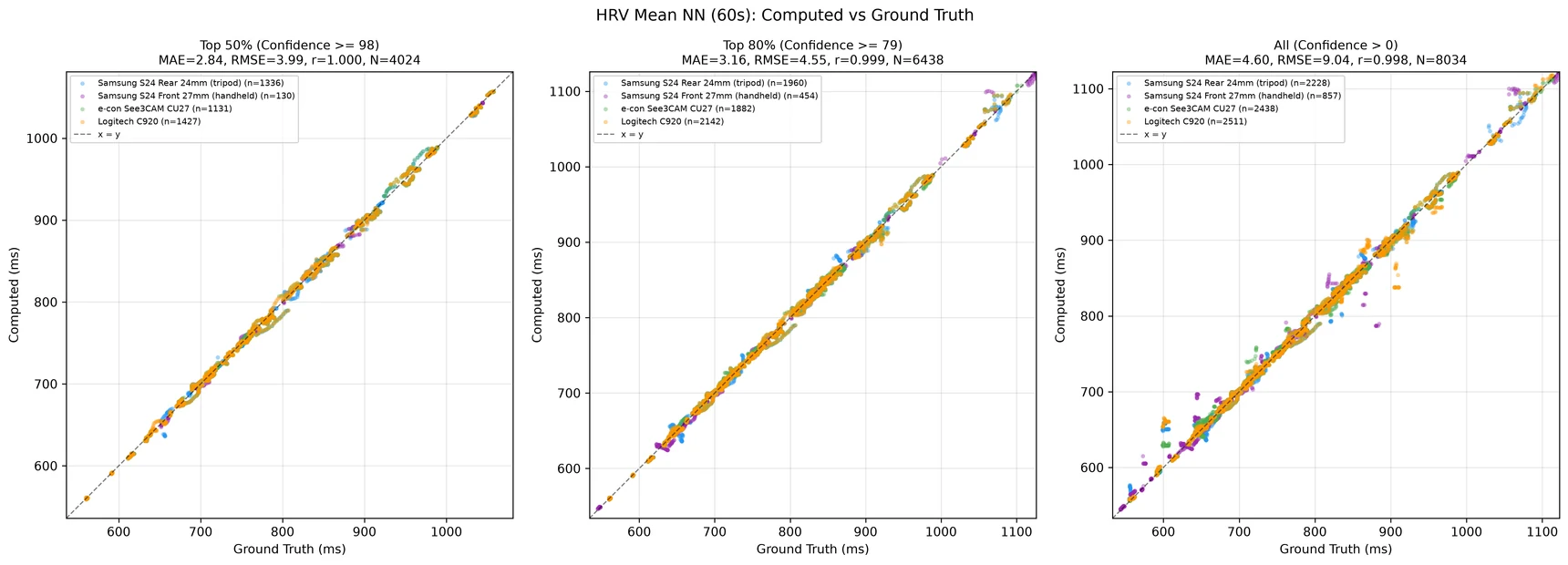
- Mean NN MAE: 3.16 ms
- Mean NN RMSE: 4.55 ms
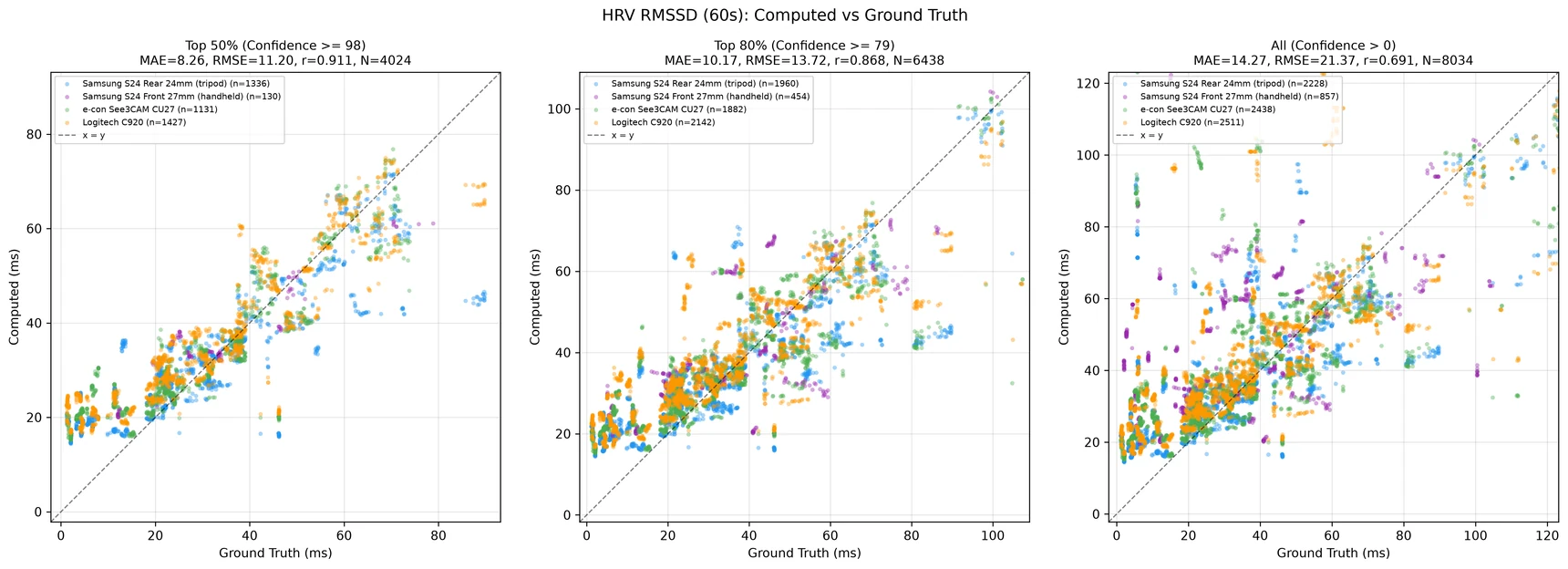
- RMSSD MAE: 10.17 ms
- RMSSD RMSE: 13.72 ms
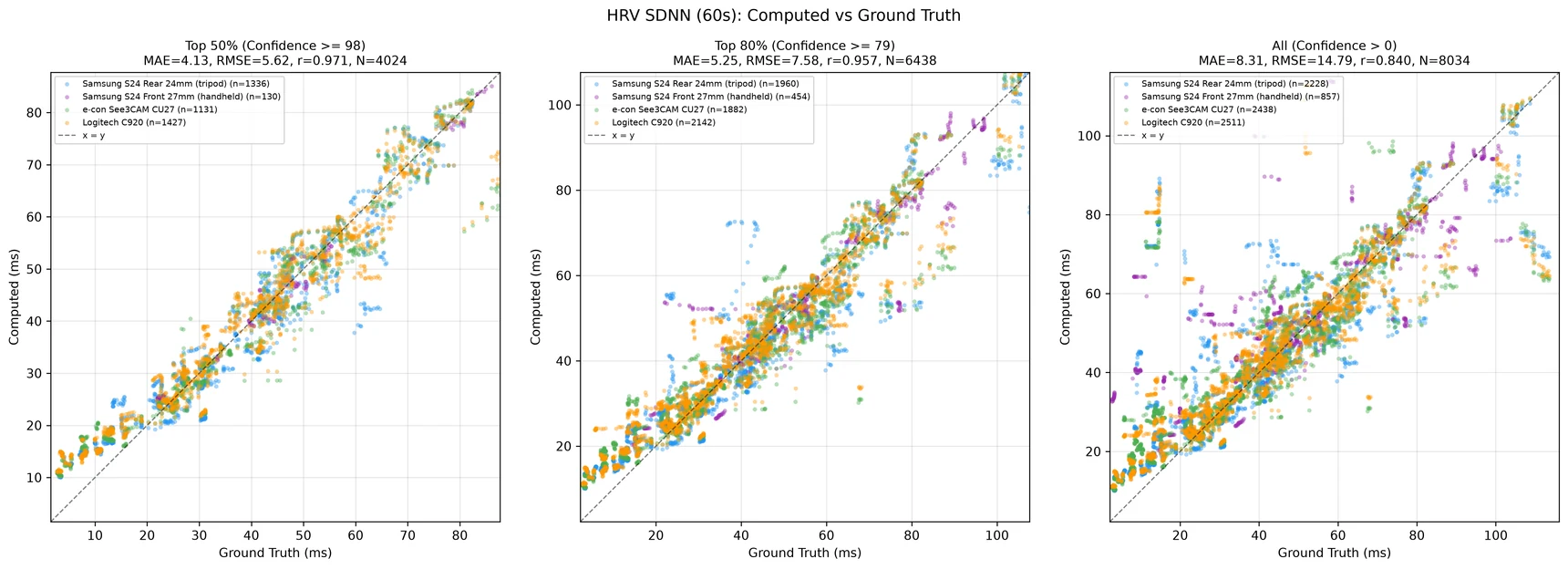
- SDNN MAE: 5.25 ms
- SDNN RMSE: 7.58 ms
8. Quantitative Analysis
Computed vs Ground Truth at Confidence Thresholds
Bland-Altman Plot
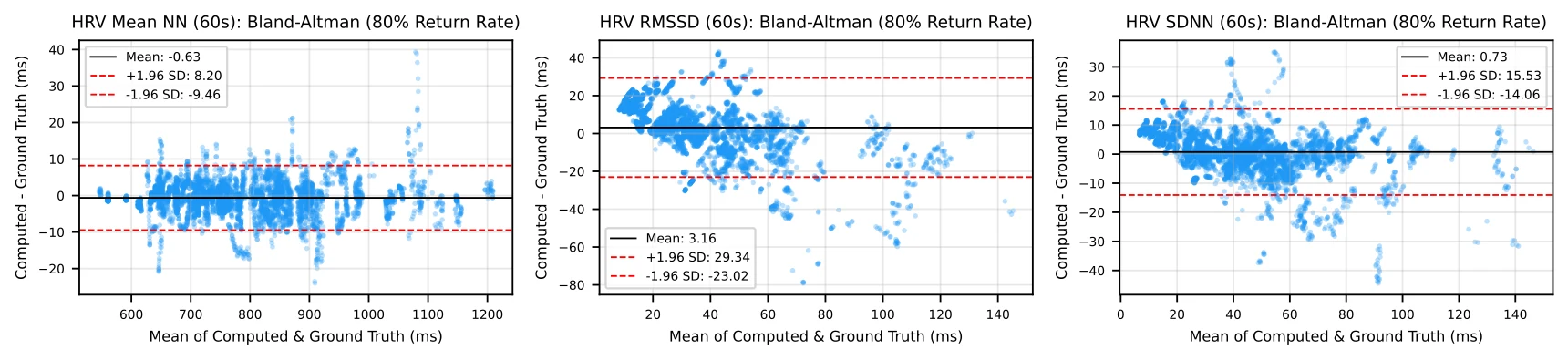
Confidence Lookup Table
| Confidence >= | Mean NN MAE (ms) | Mean NN RMSE (ms) | RMSSD MAE (ms) | RMSSD RMSE (ms) | SDNN MAE (ms) | SDNN RMSE (ms) | Return Rate (%) | N (samples) |
|---|---|---|---|---|---|---|---|---|
| 0 | 4.60 | 9.04 | 14.27 | 21.37 | 8.31 | 14.79 | 100.0 | 8034 |
| 10 | 4.60 | 9.04 | 14.27 | 21.37 | 8.31 | 14.79 | 100.0 | 8034 |
| 20 | 3.67 | 5.80 | 12.44 | 17.49 | 6.93 | 11.40 | 96.4 | 7741 |
| 30 | 3.57 | 5.50 | 12.04 | 16.64 | 6.64 | 10.71 | 95.2 | 7648 |
| 40 | 3.45 | 5.17 | 11.68 | 15.98 | 6.40 | 10.08 | 93.8 | 7537 |
| 50 | 3.36 | 4.97 | 11.19 | 15.20 | 6.06 | 9.24 | 91.4 | 7342 |
| 60 | 3.30 | 4.86 | 10.57 | 14.22 | 5.63 | 8.18 | 87.4 | 7024 |
| 65 | 3.24 | 4.75 | 10.39 | 14.03 | 5.47 | 7.88 | 85.8 | 6894 |
| 70 | 3.23 | 4.74 | 10.33 | 13.98 | 5.43 | 7.85 | 83.8 | 6736 |
| 75 | 3.23 | 4.75 | 10.31 | 13.96 | 5.41 | 7.86 | 82.2 | 6603 |
| 79 | 3.16 | 4.55 | 10.17 | 13.72 | 5.25 | 7.58 | 80.0 | 6438 |
| 80 | 3.12 | 4.42 | 10.14 | 13.65 | 5.18 | 7.43 | 79.5 | 6386 |
| 85 | 3.06 | 4.32 | 9.91 | 13.28 | 5.05 | 7.09 | 76.6 | 6155 |
| 90 | 2.89 | 4.03 | 9.65 | 12.86 | 4.87 | 6.72 | 70.1 | 5633 |
| 95 | 2.91 | 4.06 | 9.03 | 12.00 | 4.61 | 6.34 | 63.0 | 5059 |
| 96 | 2.88 | 4.05 | 8.72 | 11.56 | 4.49 | 6.15 | 60.3 | 4847 |
| 97 | 2.81 | 3.93 | 8.53 | 11.40 | 4.27 | 5.73 | 55.6 | 4465 |
| 98 | 2.84 | 3.99 | 8.26 | 11.20 | 4.13 | 5.62 | 50.1 | 4024 |
| 99 | 2.94 | 4.12 | 7.63 | 10.67 | 3.84 | 5.32 | 41.1 | 3298 |
Performance
(at 80% Return Rate, Confidence >= 79)
By Camera Type
| Camera Type | N (samples) | Return Rate (%) | Mean NN MAE (ms) | Mean NN RMSE (ms) | RMSSD MAE (ms) | RMSSD RMSE (ms) | SDNN MAE (ms) | SDNN RMSE (ms) |
|---|---|---|---|---|---|---|---|---|
| Samsung S24 Rear 24mm (tripod) | 1960 | 88.0 | 3.38 | 4.90 | 10.20 | 14.19 | 5.74 | 8.58 |
| Samsung S24 Front 27mm (handheld) | 454 | 53.0 | 3.31 | 5.50 | 10.98 | 13.58 | 5.26 | 8.48 |
| e-con See3CAM CU27 | 1882 | 77.2 | 3.17 | 4.39 | 9.70 | 13.41 | 5.11 | 7.20 |
| Logitech C920 | 2142 | 85.3 | 2.91 | 4.11 | 10.39 | 13.60 | 4.92 | 6.68 |
By Fitzpatrick Skin Type
| Fitzpatrick | N (samples) | Return Rate (%) | Mean NN MAE (ms) | Mean NN RMSE (ms) | RMSSD MAE (ms) | RMSSD RMSE (ms) | SDNN MAE (ms) | SDNN RMSE (ms) |
|---|---|---|---|---|---|---|---|---|
| Type I | 1275 | 96.1 | 3.87 | 5.86 | 8.24 | 10.75 | 3.50 | 4.77 |
| Type II | 873 | 95.0 | 2.45 | 3.16 | 6.93 | 8.92 | 4.09 | 5.37 |
| Type III | 959 | 94.4 | 4.08 | 5.30 | 8.41 | 11.20 | 4.93 | 7.73 |
| Type IV | 1441 | 86.0 | 2.91 | 4.27 | 9.62 | 12.56 | 5.16 | 6.54 |
| Type V | 1540 | 68.1 | 2.62 | 3.56 | 12.71 | 16.17 | 6.44 | 8.71 |
| Type VI | 350 | 42.0 | 3.09 | 4.78 | 21.20 | 26.47 | 10.57 | 15.14 |
| Fitzpatrick Type VI: Breakdown by Lighting Condition | ||||||||
| Ring Light | 165 | 56.1 | 2.20 | 2.90 | 19.06 | 20.17 | 8.23 | 9.65 |
| Window | 17 | 6.3 | 6.25 | 7.12 | 25.11 | 27.55 | 6.70 | 7.08 |
| Lamp | 130 | 55.6 | 3.99 | 6.44 | 26.42 | 35.05 | 15.03 | 21.78 |
Note: Types I-V are composites across all lighting conditions (Ring Light, Window, Lamp).
By Sex
| Sex | N (samples) | Return Rate (%) | Mean NN MAE (ms) | Mean NN RMSE (ms) | RMSSD MAE (ms) | RMSSD RMSE (ms) | SDNN MAE (ms) | SDNN RMSE (ms) |
|---|---|---|---|---|---|---|---|---|
| Male | 3317 | 84.6 | 3.34 | 4.77 | 8.61 | 11.39 | 4.68 | 6.44 |
| Female | 3121 | 75.9 | 2.95 | 4.30 | 11.84 | 15.83 | 5.86 | 8.63 |
By Age Group
| Age Group | N (samples) | Return Rate (%) | Mean NN MAE (ms) | Mean NN RMSE (ms) | RMSSD MAE (ms) | RMSSD RMSE (ms) | SDNN MAE (ms) | SDNN RMSE (ms) |
|---|---|---|---|---|---|---|---|---|
| 18-25 | 1953 | 84.8 | 4.33 | 5.97 | 8.53 | 12.03 | 5.15 | 7.78 |
| 26-35 | 2044 | 79.0 | 2.89 | 3.75 | 7.76 | 11.55 | 4.11 | 6.81 |
| 36-45 | 865 | 73.7 | 2.79 | 3.83 | 12.99 | 15.34 | 5.71 | 7.30 |
| 46-55 | 772 | 82.1 | 1.69 | 2.09 | 15.31 | 16.79 | 6.86 | 8.13 |
| 56-65 | 728 | 87.7 | 2.45 | 4.37 | 10.42 | 13.41 | 5.38 | 6.42 |
| 65+ | 14 | 10.7 | 6.13 | 7.19 | 30.32 | 30.35 | 7.25 | 7.57 |
By Lighting Type
| Lighting | N (samples) | Return Rate (%) | Mean NN MAE (ms) | Mean NN RMSE (ms) | RMSSD MAE (ms) | RMSSD RMSE (ms) | SDNN MAE (ms) | SDNN RMSE (ms) |
|---|---|---|---|---|---|---|---|---|
| Lamp | 2085 | 81.2 | 3.55 | 5.38 | 9.39 | 13.53 | 5.19 | 8.57 |
| Ring Light | 2250 | 83.7 | 2.82 | 3.75 | 10.99 | 14.62 | 5.17 | 7.14 |
| Window | 1234 | 67.4 | 3.47 | 4.97 | 9.08 | 11.43 | 4.91 | 6.13 |
9. Fairness & Equity
Bias Assessment Methodology: Performance is stratified by Fitzpatrick skin type (I-VI), sex, camera type, and age group. Per-group metrics and Confidence averages are reported in the Quantitative Analysis tables above.
10. Ethical Considerations
As a remote sensing device, the risks posed to the subjects in the trial are minimal, including the association of each subject with corresponding biometric data. Mitigation of these risks include de-identifying all subject data, including videos, prior to saving it. Additionally, all data is securely stored with access to a select number of trained researchers.The model is not intended for human life-critical decisions, diagnostics or prognostication.
11. Limitations and Tradeoffs
- Requires at least 60 seconds of uninterrupted facial view
- Works best in stationary conditions
- HRV metrics are sensitive to motion artifacts
- Currently only measures a single subject at a time