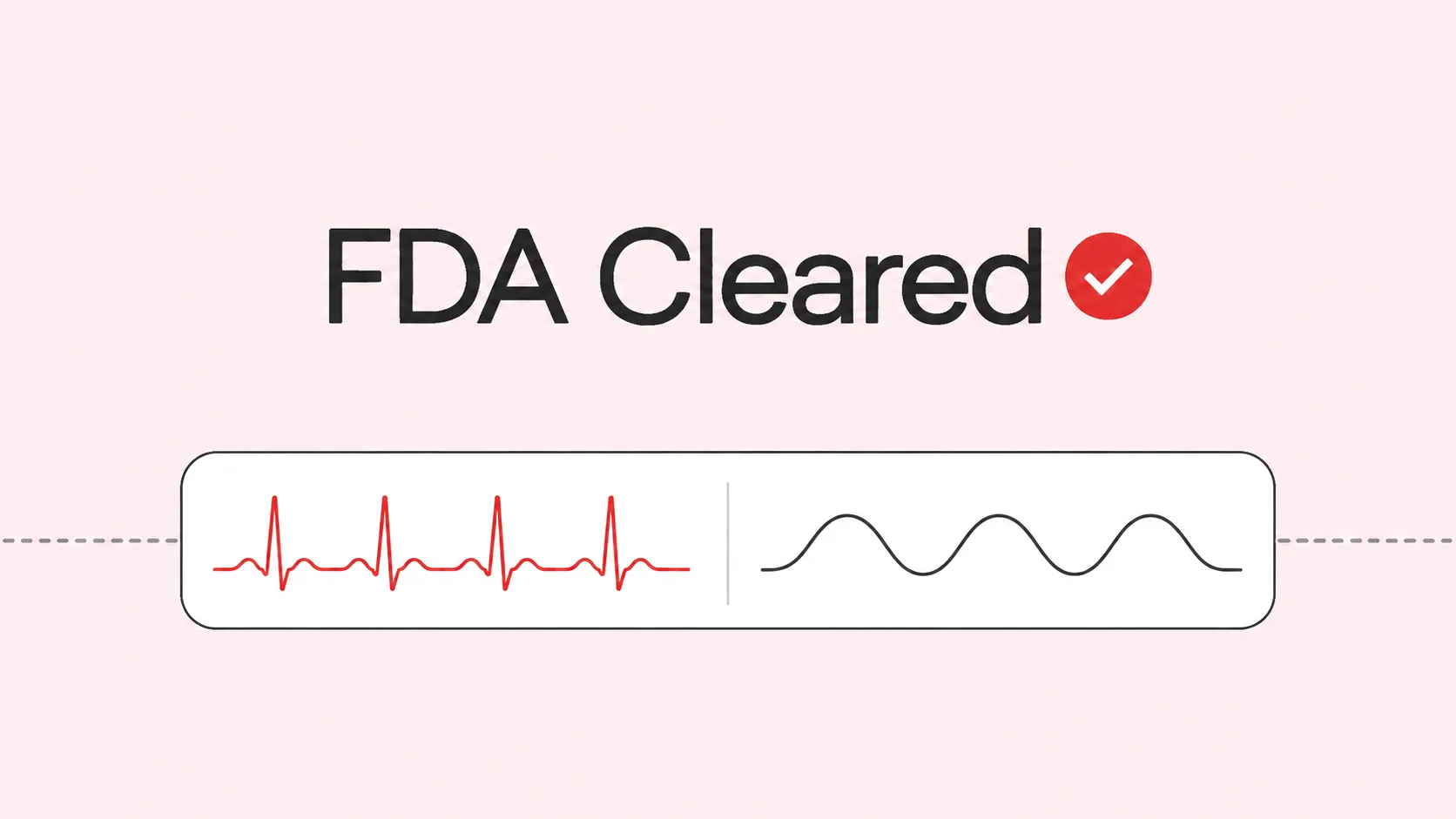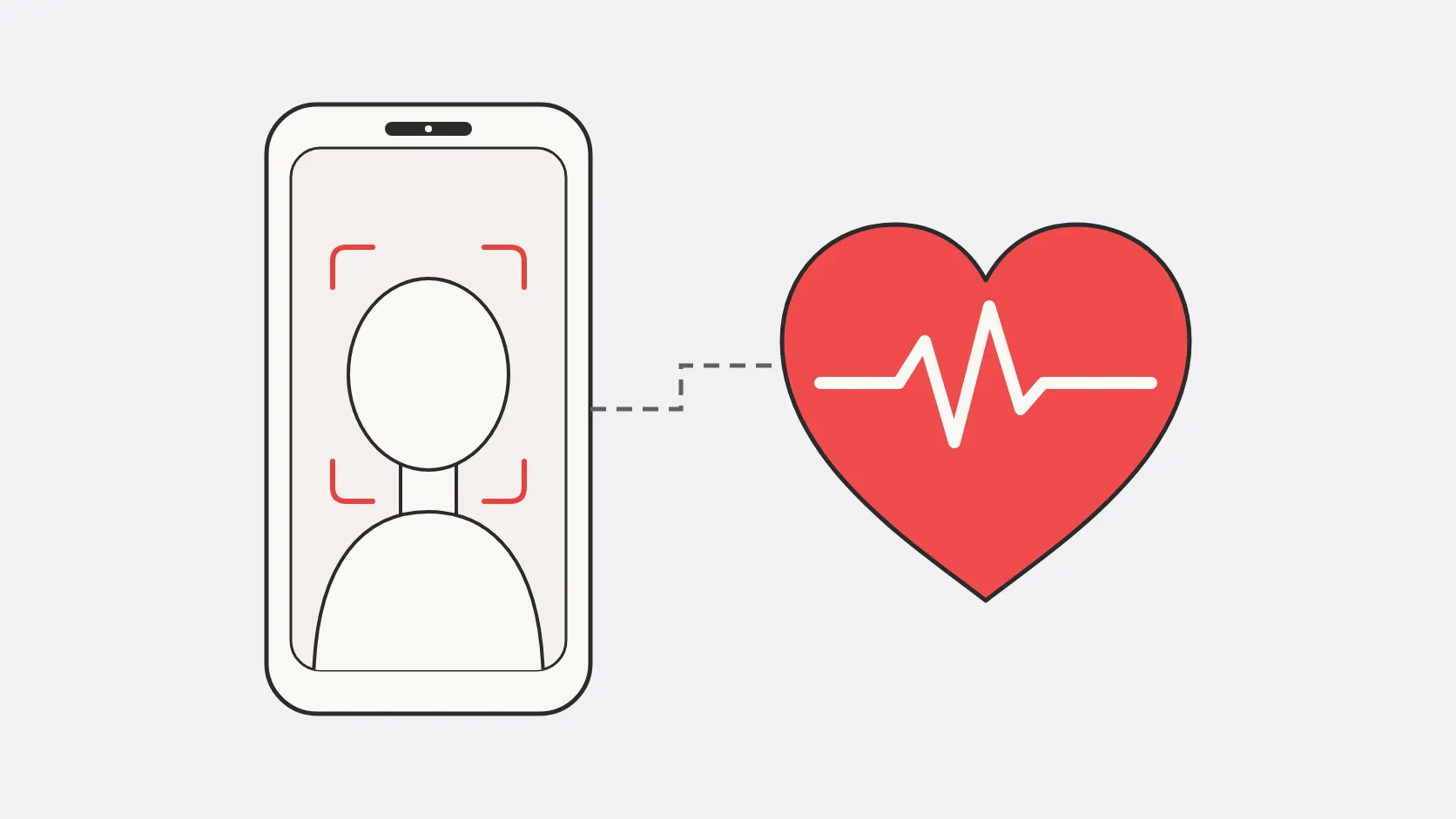
Yes. You can measure your heart rate from your phone camera with no smartwatch or chest strap, and, with a face scan, without touching your skin. The FDA even has a device category for camera-based pulse and respiratory rate software (21 CFR 870.2785), and Presage’s SmartSpectra Vital Signs Monitor 1.0 is among the systems cleared under it for use in clinical settings. But not every app that claims to measure heart rate has been tested, and the difference matters if you rely on the number.
This guide explains how a phone camera actually sees your pulse, how accurate the best-tested methods are, and what to look for before you trust an app.
Key takeaways
- Cameras detect your pulse from tiny color changes in your skin or slight motion with each heartbeat. Face-scan methods use remote photoplethysmography (rPPG).
- There are two approaches: pressing a finger over the lens, or scanning your face from a distance.
- Accuracy depends on how the method was built and tested. Look for comparison against an ECG or clinical monitor, a Bland-Altman analysis rather than a correlation alone, and testing across skin tones.
- Light, motion and talking are common sources of error. Sit still in even light for the best reading.
How a phone camera measures heart rate
Every heartbeat pushes a wave of blood through your body. That wave slightly changes how much light your skin absorbs and reflects. The change is far too small to see in a mirror, but a camera recording at a steady 25 to 30 frames per second can pick it up (SmartSpectra measurement guide).
Remote photoplethysmography (rPPG) is a way to measure heart rate with a camera instead of a sensor on your skin. Software tracks those tiny color shifts and subtle motion across your face over time, filters out noise from large movements and lighting, and finds the rhythm underneath. That rhythm is your pulse.
The underlying principle, photoplethysmography, is the same one used by the clip-on sensor a nurse puts on your finger and by the green lights on the back of a smartwatch. Those devices shine their own light into your skin. rPPG works at a distance, using the light already in the room.
Breathing can be measured from the same video in a different way: by tracking the small rise and fall of your chest and shoulders.

Two ways to check your heart rate with your phone
Most camera heart rate monitor apps use one of two very different approaches.
| Finger on the lens | Face scan | |
|---|---|---|
| Technique | Contact PPG | Remote PPG (rPPG) |
| Camera | Rear camera, with the flash as a light source | Front camera, using the light in the room |
| Touches your skin | Yes, your fingertip covers the lens | No |
| Can also measure breathing | Rarely | Some apps, from chest and shoulder motion |
Finger-on-lens apps. You press your fingertip over the rear camera and flash, and the app watches your fingertip change color with each beat. This is contact PPG. It gives a strong signal, but you have to keep your finger still and covering the lens for the whole reading.
Face-scan apps. You look at the front camera for a short measurement, often around 30 seconds, and nothing touches you. This is true rPPG, and it lets you measure heart rate without a device beyond the phone you already carry. It is harder to get right, because the signal from a face is weaker and faces move. But it is what makes camera vitals practical where handing someone a device is awkward, such as telehealth visits or quick wellness check-ins.
How accurate is camera heart rate?
It depends on who built it and how they tested it. Several companies now build rPPG into apps and developer tools, and the technology has moved well beyond the research lab. What separates them is proof. Some apps have never been compared against a medical reference, so check an app’s description for any mention of validation.
Two questions tell you most of what you need to know.
- What was it tested against, and how was agreement measured? Good validation compares the camera method side by side with an ECG or a clinical monitor, on real people. It should report a Bland-Altman analysis (explained below), not just a correlation.
- Who was it tested on? Skin tone matters. A 2020 meta-analysis of camera heart rate methods found that performance dropped significantly for the darkest skin type. A 2025 analysis of 100 studies in npj Digital Medicine found that darker skin tones are still significantly underrepresented in the public datasets these methods are trained on. Melanin absorbs more light, so darker skin reflects less signal back to the camera. Good, even lighting improves the signal. A credible developer will tell you which skin tones, ages and lighting conditions were included.
Why Bland-Altman analysis matters
Many camera heart rate claims lead with a correlation, such as an R of 0.99. A high correlation only shows that two methods rise and fall together. It does not show that they agree. A camera that always reads 10 beats per minute too high would still correlate almost perfectly with an ECG.
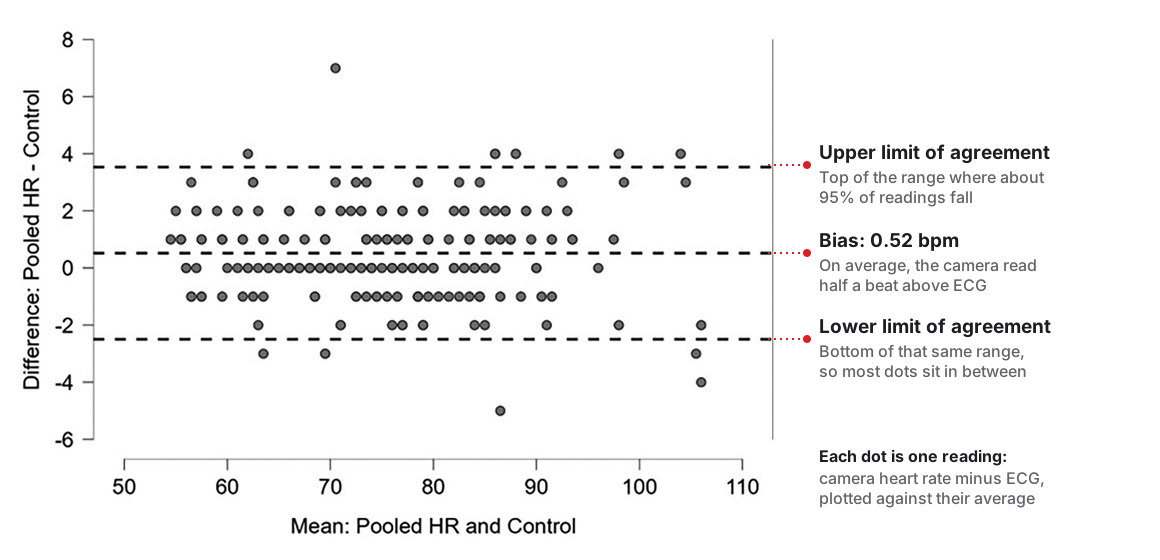
Bland-Altman analysis, introduced by statisticians Martin Bland and Douglas Altman in a 1986 paper in The Lancet, was designed for exactly this problem. For every reading, it plots the difference between the two methods against their average, and it answers three practical questions:
- Bias: on average, does the camera read high or low compared with the reference?
- Limits of agreement: how far apart can a single reading be? This is the range that about 95% of individual differences fall within.
- Trends: does the error grow at higher or lower rates, for example during a fast heart rate?
For anyone deciding whether to trust a single reading, the limits of agreement matter most. A small bias with wide limits means the average looks good but any one measurement could be well off. Narrow limits mean individual readings stay close to the reference. In the study below, the practical answer is that 96% of camera heart rate readings landed within 3 beats per minute of ECG.
What Presage’s evidence shows
In a peer-reviewed study of 111 participants at Baylor College of Medicine, published in Frontiers in Medical Technology in 2026, camera measurements were compared with ECG for heart rate and with capnography for respiratory rate. The Bland-Altman analysis showed no systematic bias or trends. The mean difference from the reference was 0.52 beats per minute for heart rate and −0.18 breaths per minute for respiratory rate, and 96% of heart rate readings were within 3 beats per minute of ECG.
The software produced a heart rate reading in 278 of 333 attempts (83%) and a respiratory rate reading in 314 of 333 (94%). Participants covered all six Fitzpatrick skin types.
The study used healthy volunteers, all in normal sinus rhythm, with fixed cameras and lighting. Read the full study in Frontiers in Medical Technology, or browse more of Presage’s published research.
A separate validation study in the FDA 510(k) Summary for the SmartSpectra Vital Signs Monitor 1.0 reports Bland-Altman results for respiratory rate across 95 subjects and 555 observations. It found a bias of 0.03 breaths per minute, with limits of agreement from −2.17 to 2.23 breaths per minute.
Presage’s SmartSpectra Vital Signs Monitor 1.0 is FDA 510(k) cleared (K254169) for spot measurement of pulse rate and respiratory rate on iPhone and Android.
If you are comparing options, ask every vendor the same two questions: what was it tested against, and who was it tested on?
What to look for in a camera heart rate app
Your phone camera can measure heart rate, and the best-tested methods have been validated against a three-lead ECG in peer-reviewed studies. The catch is that quality varies widely between apps. Look for published validation, testing across skin tones, and a clear explanation of how the app was checked against a reference.
If you are a developer building health features into your own app, Presage offers the SmartSpectra SDK. The SmartSpectra SDK docs show how to add camera-based heart rate and breathing rate on iOS, Android and desktop, with a free trial API key.
For step-by-step setup, start with the iOS (Swift) quickstart or the Android quickstart.
Frequently asked questions
How do I check my heart rate with my phone?
Use a camera heart rate app. Either press your fingertip over the rear camera and flash, or sit facing the front camera for a face scan. Follow the app’s on-screen guidance, keep the phone steady and stay still until the reading finishes. How accurate the result is depends on how the app was tested.
Can an iPhone or Android phone measure heart rate without a smartwatch?
Yes. Camera heart rate apps work on both iPhone and Android, using either a finger over the rear camera or a face scan with the front camera. You don’t need a smartwatch or any other wearable.
Does camera heart rate work on all skin tones?
It can, but only if the developer built and tested for it. It is also important to note that, unless the capability was built for Infrared Cameras, none of them work in the dark because they need sufficient room lighting to see the subtle color changes in the skin. Research has shown that some methods perform worse on the darkest skin tones. In the Baylor study of Presage’s method, participants covered all six Fitzpatrick skin types, and the FDA 510(k) Summary for the SmartSpectra Vital Signs Monitor 1.0 reports that performance was consistent across sex, age, body mass index and Fitzpatrick skin tone.